



The Nine Major Allergens Under New York Law
This list matches the federal definition set out under FALCPA and the FASTER Act — both New York laws use the identical nine allergens, so there's only one list to learn
New York's Two Allergen Laws: §1356 and §1357 Explained
This is the part most articles on this topic skip entirely — and it matters, because one of these laws is already enforceable today, not landing in the future.
§1356, the older and already-active law, was recently expanded to cover food intolerances alongside allergies. Every restaurant and catering establishment in the state needs a staff poster covering allergy procedures (in the languages your staff actually speak), a menu notice telling customers to flag any allergy or intolerance, and — critically for anyone taking online orders — a way for customers to indicate an allergy or intolerance when ordering digitally.
§1357, the new law everyone's talking about, closes a different gap. It requires a simple written allergen notice — a sticker is enough — on any food you prepare and package on-site for customers to take away. It does not require you to list every ingredient, just to flag which of the nine major allergens are present.
If you're doing anything with digital menus or online ordering, §1356 is the one to act on first, since it's already enforceable. §1357 is the one with the clock ticking toward November.
The Story Behind New York's Allergen Labeling Law
New York's §1357 didn't start in a lobbyist's office, it started with a teenager who couldn't tell if a bakery item was safe to eat.
Jared Saiontz, a high school student with multiple food allergies, grew frustrated repeatedly being unable to tell whether prepackaged deli and bakery items were safe for him. Working with his mother, an attorney, and another advocate, he brought the idea to State Senator Pete Harckham, who introduced the Senate bill in February 2025. Assembly member Jen Lunsford sponsored the companion Assembly bill the following month — and she had her own reason to care: her son suffered an anaphylactic reaction to a bakery cookie as a toddler. The bill passed both chambers by June 2025 and was signed into law that November, making New York the first U.S. state to require this kind of packaging-level allergen disclosure.
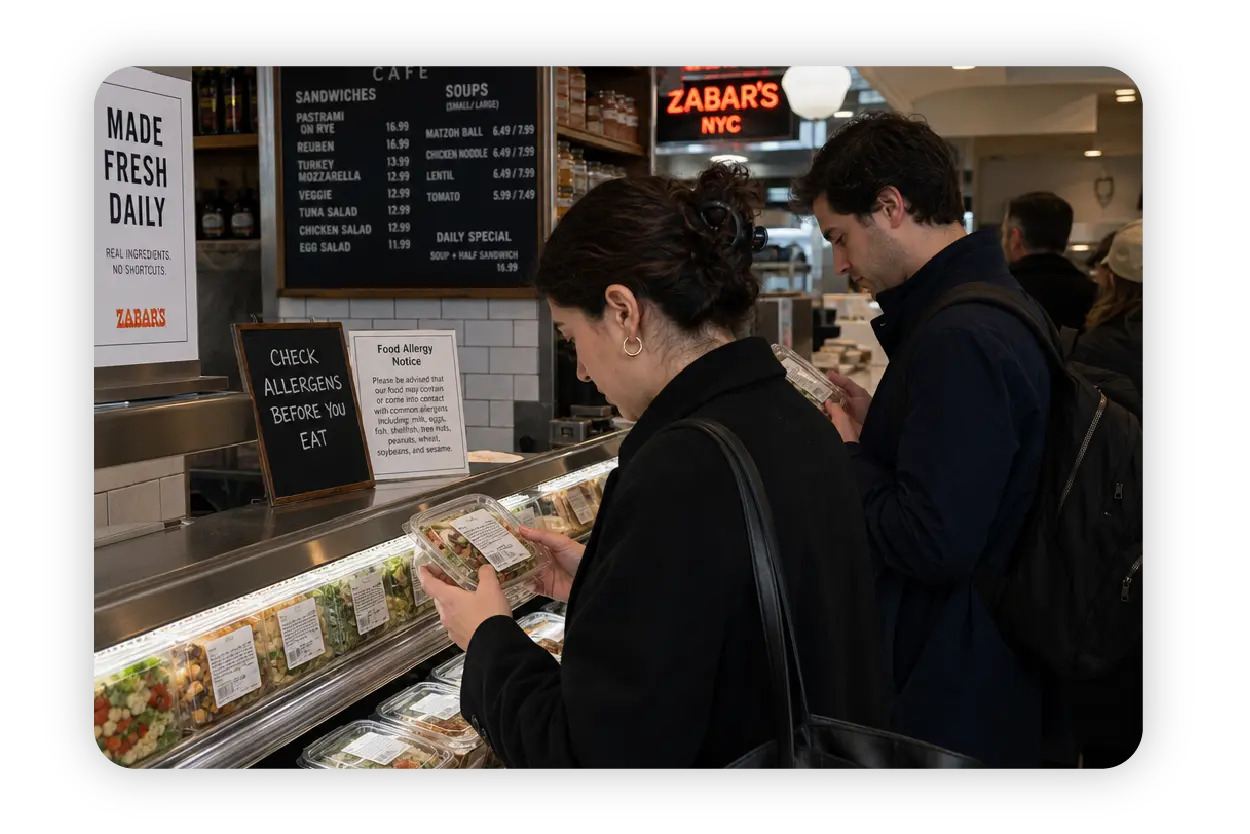
It's a useful reminder that this law exists because of a real, common, everyday moment — someone standing at a bakery counter, unsure if what's in front of them is safe.
.webp)
What Counts as "Prepackaged Food" Under NY's Allergen Law
The distinction that matters: if the packaging happens before someone orders it, it's covered. If it happens after, it isn't. This is the same line the FDA draws federally for factory-packaged goods — New York is simply extending it to food made in-house.
Who Needs to Comply With New York's Allergen Law
The law applies regardless of business size. A single counter carries the same obligation as a fifty-location chain. It directly covers:
- Bakeries and patisseries
- Delis and specialty food retailers
- Cafés and coffee shops selling packaged pastries or sandwiches
- Ice cream parlors
- Sandwich shops
- Cafeterias
- Food trucks and mobile food units
- Retail food stores selling prepared, packaged items
A note for healthcare, education, and corporate catering operations: this law isn't just a restaurant issue. Hospital and campus cafeterias selling grab-and-go items, school bakery counters, and corporate caterers packaging boxed lunches or individually wrapped items for events all fall under the same requirement. Multi-site operators in these sectors face a harder version of the same problem — keeping allergen labeling consistent across every ward, campus building, or event, not just one counter.
How NY's Law Compares to Federal Allergen Law (FALCPA)
This law exists because of a real gap in federal rules. The Food Allergen Labeling and Consumer Protection Act (FALCPA), passed in 2004, established the original eight major allergens and requires them to be declared on most packaged foods sold at retail. Sesame was added as the ninth major allergen under the FASTER Act, effective January 1, 2023.
But FALCPA's labeling rules were never written to cover most food sold at retail or food-service counters that isn't pre-packaged with a factory label — meaning a sandwich wrapped at a deli counter, or a muffin boxed at a bakery, was never federally required to carry an allergen label. New York's §1357 is the first state law to close that specific gap.
Other States With Allergen Laws (California, Michigan, Maryland & More)
New York is the first state to pass this kind of packaging-level requirement, but it's part of a broader wave of state action on allergen disclosure:
A handful of other states, including Massachusetts, Connecticut, New Jersey, and Texas already require lighter-touch measures like posted allergy notices or staff training, without a labeling mandate. The direction of travel across the country is the same: allergen transparency is moving from a courtesy to a legal requirement.
New York Allergen Law Compliance Checklist
How Kafoodle Helps With NY Allergen Compliance
The businesses most at risk here are the ones still tracking allergens on spreadsheets. One missed update, and a label or menu is wrong. Kafoodle closes that gap at the source, not just at the output.
- Ingredient Management validates allergen data the moment an ingredient enters your system, so errors never make it into a recipe in the first place.
- Recipe Database automatically calculates allergen content from your validated ingredients and generates compliant labels ready to print or affix to packaging, and updated instantly if a recipe changes.
- Menus apply the same allergen data to your physical and digital menus, so your website and your printed menu never fall out of sync.
If you're running multiple counters, sites, or a growing bakery-café concept, this is worth seeing in action: explore Kafoodle's allergen labeling software.
One bakery that's already solved this exact problem: see how Libby's Sugar & Gluten Free Bakery manages allergen labeling at scale.
Multi-site café and pub groups facing the same challenge can also see how Roots & Berries keeps allergen data consistent across 9 sites and how Stange & Co manages allergen compliance across its pub estate.
Sources & Further Reading
- New York State Senate — Public Health Law §1357
- U.S. Food & Drug Administration — Food Allergies
- Allergic Living — NY Law Brings Allergen Labeling to Deli, Bakery & Packaged Foods
- Spencer Fane — Additional Legislation Expected to Mandate Food Allergen Disclosures